Search results for tag #bsd

Older Intel Wi-Fi cards on FreeBSD have struggled with performance for years.
HyprBSD now has a kernel that improves performance on Intel 7000, 8000 and 9000 series cards, with up to 8x faster uploads in testing.
Only affected hardware gets the patched kernel. Everyone else keeps stock FreeBSD.
FreeBSD security updates always take priority.

Latest 𝗩𝗮𝗹𝘂𝗮𝗯𝗹𝗲 𝗡𝗲𝘄𝘀 - 𝟮𝟬𝟮𝟲/𝟭𝟭/𝟮𝟯 (Valuable News - 2026/11/23) available.
https://vermaden.wordpress.com/2026/11/23/valuable-news-2026-11-23/
Past releases: https://vermaden.wordpress.com/news/
#verblog #vernews #news #bsd #freebsd #openbsd #netbsd #linux #unix #zfs #opnsense #ghostbsd #solaris #vermadenday
Latest 𝗩𝗮𝗹𝘂𝗮𝗯𝗹𝗲 𝗡𝗲𝘄𝘀 - 𝟮𝟬𝟮𝟲/𝟭𝟭/𝟭𝟲 (Valuable News - 2026/11/16) available.
https://vermaden.wordpress.com/2026/11/16/valuable-news-2026-11-16/
Past releases: https://vermaden.wordpress.com/news/
#verblog #vernews #news #bsd #freebsd #openbsd #netbsd #linux #unix #zfs #opnsense #ghostbsd #solaris #vermadenday


I've always appreciated the simplicity of the BSDs. Power, yes, but without unnecessary complexity.
BastilleBSD and vm-bhyve have been my trusted companions for many years. But whenever I used Linux, I missed them.
That's why, years ago, I started putting together a collection of shell scripts (and some Python, although to a much lesser extent) to create something somewhere in between.
A bit of Bastille, a bit of vm-bhyve, a bit of Proxmox: unprivileged Linux system containers and virtual machines, managed from the command line.
Live backups. And live restore: bringing a workload back online before all its data has finished copying from the backup. Multiple storage backends. Encryption at the storage or individual workload level. Different networks. Isolation of each workload (a bit like illumos zones), with additional layers of protection.
Each container has its own UID/GID mapping. VMs run under separate unprivileged identities, with namespaces, seccomp and resource limits adding further layers of protection.
Pull-based backups from external hosts, with different levels and types of encryption. With raw encrypted ZFS replication, the backup server doesn’t even need the decryption keys. Backups are pulled over SSH by an external server. The workload host holds no credentials to log in to that server.
It also runs on a 1 GB Orange Pi PC 2, where I’ve tested both containers and native ARM64 KVM guests. And on a Orange PI One, armv7 and 512MB, it can run some lxc containers without problems, from the SD, using f2fs.
Simple disaster recovery. Because after those 142 servers went up in flames in Strasbourg, disaster recovery became something I care a lot about.
Currently supported and tested on Alpine Linux, Debian 13 and Armbian. On Debian, LXC containers also run under enforcing AppArmor profiles, adding another layer of protection.
Few commands. Lots of power. And it's called "Jail It!"
I'm not going to release it, at least not for now. I need to focus on my other projects, and Jail It! still needs some cleaning up.
But it works. And it does its job very well.
For containers, there's absolutely nothing running in the background. For VMs, just a small Python helper. No continuously running services. You connect via SSH, run your commands, and that's it.
Still, for anyone curious enough to have a look, I've put together a short demo on Asciinema:
https://asciinema.org/a/BbwGs99U9UJDLAzZ
Well, "short" might be a bit of an exaggeration. It's quite long, but I think it's worth watching all the way to the end.
#Linux #LXC #KVM #FreeBSD #Virtualization #OwnYourData #BSD #SelfHosting #Homelab #SysAdmin #DisasterRecovery
Latest 𝗩𝗮𝗹𝘂𝗮𝗯𝗹𝗲 𝗡𝗲𝘄𝘀 - 𝟮𝟬𝟮𝟲/𝟭𝟭/𝟬𝟵 (Valuable News - 2026/11/09) available.
https://vermaden.wordpress.com/2026/11/09/valuable-news-2026-11-09/
Past releases: https://vermaden.wordpress.com/news/
#verblog #vernews #news #bsd #freebsd #openbsd #netbsd #linux #unix #zfs #opnsense #ghostbsd #solaris #vermadenday
... [SENSITIVE CONTENT]
#Linux became #slopware. The best #GNU/Linux distro still depends on #AI
slop. #Hurd is not ready yet. #Hyperbola #BSD needs support in order to
fully properly switch from a #GNU/Linux OS to a GNU? #BSD one.
Depressing times, but maybe enlightening ones too. Linux since 1996 was
just a corporate workauround to drive commercial Unix tools on it.
In the end #IBM won. My tip for the #GN[U] develoepers for #GUIX:
consider Unix dead. Don't try to resurrect it. It's finished, rotten,
bloated, propietarized, outdated. Ironically the licensed GPLv2 kernel
with less blobs than Linux came from AT&T and it's Unix 2.0.
They already did Unix better than Unix itself. Either you focus and enhance
#Hurd, or lose against the blobslop OS. Make an outstanding FS on Hurd.
Give more rights to the user than the shitty layers of #dbus/#polkit and the
like to fix the lack of proper namespaces on Linux.
I said 'proper', Plan9/9front it's light years ahead.
Don't get just 'well enough' with X11/wayland. You can do better stuff.
Ditto with Emacs, forget coreutils, reimplement everything you
can with jitted Elisp and Elisp code replacing these outdated Unix
tools. Eshell can be a better shell. The 9front folks already did it
with 'rc' simplyfing Unxi shells to the extreme.

No quedó un registro audiovisual de la charla pero espero poder dejarlo por escrito en mi web personal en unos días.
Alt...
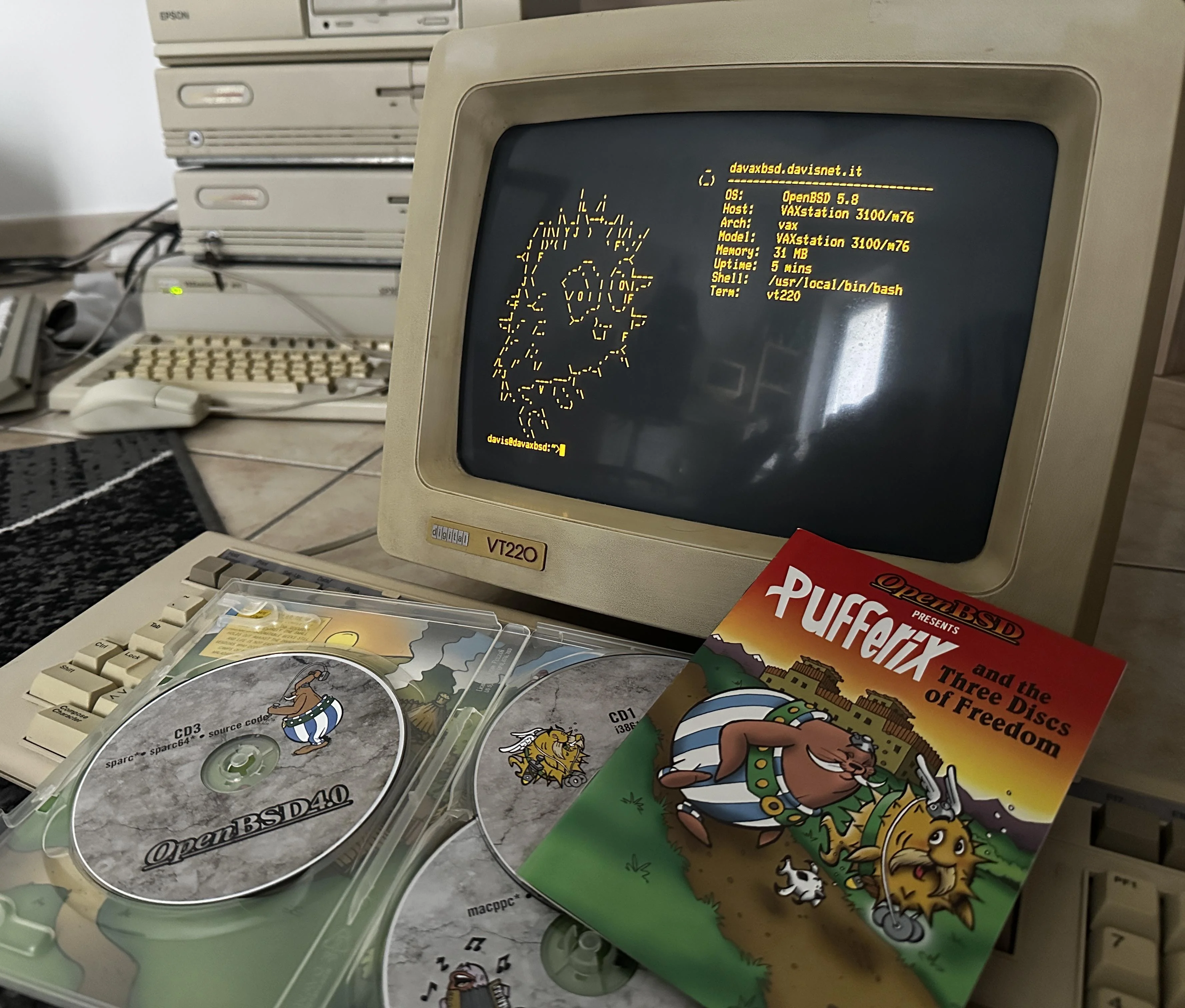
OpenBSD 5.8 en una VAX con terminal vt220

Bueno, comenzamos la migración de la comunidad Tilde Undernet al nuevo servidor dedicado OpenBSD y estamos finalizando el nuevo servidor de respaldo cifrado redundante. Luego de todo esto, se viene una tremenda, pero no voy a adelantar nada aún #tilde #undernet #plaintext #textoplano #openbsd #bsd #pubnix #uruguay

Alt...
NeoFetch de servidor OpenBSD de Tilde-Undernet
... [SENSITIVE CONTENT]
Sorry for my previous rant, but Richard #Stallman has been predicting this since *decades* from their libre ITS machines suffering corporate bullshit forever. Their own GNU project was to liberate #Unix from the #AT&T hands. Yes, it was and it's a bit bloated from the #BSD perspective, I know, I was an OpenBSD user and now #9front, but #hyperbolaBSD will try to fix that: minimalist BSD freedom with a #GNU license. And you might not need to suffer FFSv2 fscking itself again ;) as a plus.
So you if you now need a free #Unix, you know what to support. Consider anything from #Redhat/#IBM ultimately tainted. #Trisquel
it's sadly on a razors' edge. They will patch it... until they can't anymore.
#GNU #Guix it's fine, but better if you pick it bia Bittorrent under a non-US mirror.
If you want a Unix 2.0, head to #9front, but help with ath9k drivers (there are none) as they are the only ones without needing binary blobs (less opaque things to debug and a total freedom to distribute them with base).